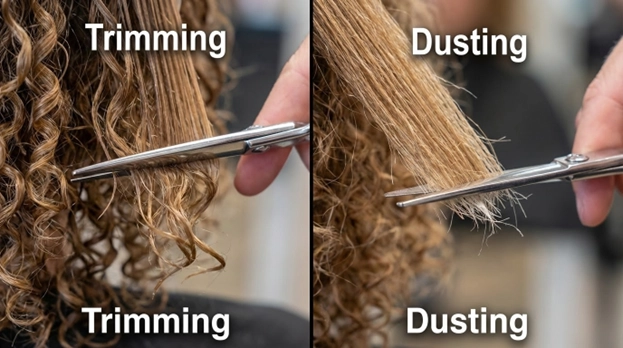
(Part 5 of 5 of our January Winter Rehab Hair mini-series) Keywords: trimming vs. dusting differences · dusting split ends technique · at-home trimming, dusting risks
Hair N’ Now NYC | Because You’re Smart
Living in New York teaches women many advanced life skills. You learn to walk fast. You learn to read rooms. You learn which subway car is safest. You also learn strategic compromise. Heels versus distance. Cashmere versus slush. Hair versus weather.
Winter is where hair ambition meets atmospheric resistance. You want length. The city wants friction. You want shine. The city offers wind tunnels, radiators, scarves, and static. You want low maintenance. New York snarks, “Cute idea.”
Every winter, smart women face the same quiet dilemma. Do I protect my length or protect my sanity? Do I chase growth or preserve what survived last winter? Do I ignore my ends and hope spring forgives me?
Hair grows. That part is easy. Keeping it once it arrives is the sport. Especially here.
New York winter hair damage is subtle. It sneaks. It whispers. It does not announce itself dramatically. It shows up as dullness, tangles, lost shape, and ends that suddenly feel argumentative.
You did nothing wrong. You walked outside.
Cold air steals moisture. Indoor heat finishes the job. Scarves rub. Coats tug. Ponytails tighten. Elevators create static storms. Your hair lives in a city that does not apologize.
So, women adapt. We choose smarter coats. Better boots. Stronger moisturizers. Then we stare at our hair and hesitate.
Cut it? Or barely touch it?
This is where trimming and dusting enter the conversation. Not as dramatic haircuts. As survival strategies.
These techniques are not about change. They are about defense. They protect length. They preserve style. They prevent future regret.
In New York, prevention is always cheaper than repair.
Understanding the difference matters. Especially in winter. Especially if you like your hair. Especially if you worked hard for it.
Let’s talk about how smart women keep their hair intact while the city tries its best.
What Trimming Really Does
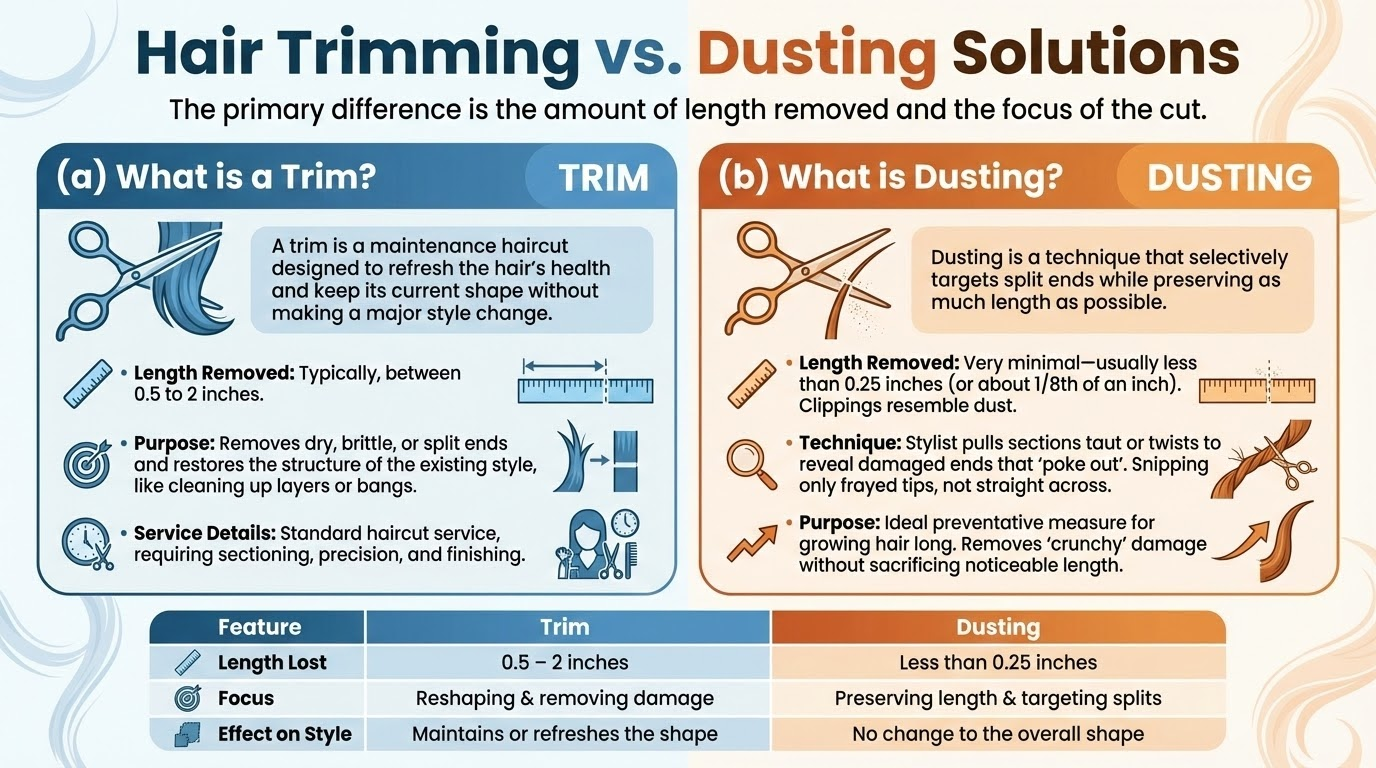
A trim removes a small, visible amount of length. Usually a quarter to one inch.
It refreshes shape. It resets the perimeter. It removes weakened ends completely.
Trimming is maintenance, not betrayal.
In winter, trims stop damage from climbing upward. Split ends travel. They unzip the hair shaft. Stylists call this the “Zipper Effect.”
Once a split starts, it rarely stops politely. It keeps going until cut.
A trim acts like cauterization. Clean cut. Clean edge. No invitation for damage to spread.
Trims also improve styling. Hair behaves better when ends are strong. Blowouts last longer. Curls bounce back. Flat irons require fewer passes.
Less heat means less damage. Winter already gives enough problems.
Trimming does not make hair grow faster. That myth refuses to retire.
It does help hair stay longer. Growth without retention is just shedding with ambition.
If your ends feel thin, brittle, or shapeless, a trim is usually the answer.
What Dusting Actually Means
Dusting is precision maintenance. It removes only the damaged tips.
We are talking millimeters. Sometimes less.
Dusting targets frayed ends along the hair shaft. Not a straight line. Individual offenders.
It preserves visible length while improving smoothness.
Dusting is ideal when hair feels rough but looks long. When you want polish, not change.
It is also ideal for commitment issues.
Done correctly, dusting makes hair feel healthier without looking shorter.
That is why it became popular with long-hair loyalists.
Dusting requires patience. It is slow. It is meticulous. It is not a rush job.
Stylists isolate sections. They find splits. They remove only what failed.
The goal is retention. Not reinvention.
Why Winter Makes Both Necessary
Winter attacks hair structure.
Cold air holds less moisture. Hair dries faster. Elasticity drops.
Indoor heat continues the dehydration. All day. Every day.
Dry hair snaps instead of stretches.
Accessories add friction. Scarves, coats, and hats rub constantly. Especially at the nape.
Static causes flyaways and tangles. Detangling causes breakage.
Circulation slows in cold weather. Follicles receive fewer nutrients.
Hair may grow slower. Ends still suffer faster.
Maintenance cuts protect what you already earned.
They ensure growth is not immediately sacrificed to breakage.
In winter, trimming and dusting are not indulgent. They are defensive driving.
Length Retention Versus Growth
Hair grows from the scalp. End of discussion.
But length is kept at the ends.
If ends break faster than hair grows, length disappears.
Maintenance cutting improves retention. That is the real win.
Dusting preserves length appearance. Trimming preserves structural integrity.
Most women need both at different times.
Winter usually decides which.
Why DIY Is Risky Business
At-home trimming sounds responsible. It rarely ends that way.
The biggest problem is tools. Kitchen scissors tear hair. Craft scissors shred it.
Dull blades create new split ends instantly.
Technique matters. Sectioning matters. Angles matter.
Haircutting is trained muscle memory. Not intuition.
The back of your head remains a mystery. Mirrors lie.
Uneven lengths happen fast. Correcting them removes more hair.
Cutting wet versus dry matters. Shrinkage surprises people.
Most DIY mistakes require professional correction. Shorter correction.
Dusting at home is even trickier.
It requires identifying damaged ends without cutting healthy growth.
Miss the mark and hair looks thin. Or frizzy. Or both.
Textured hair complicates everything. Curl patterns hide splits.
Straightening first adds heat damage to the plan.
DIY often costs more later. In inches.
Product Support by Hair Type
For Straight / Low Texture Hair
Lightweight protection works best.
Bond builders strengthen without weight.
Split end sealers restore shine and smoothness.
Avoid heavy oils. Winter does not mean greasy.
- Olaplex No. 0 Intensive Bond Building Treatment + No. 3 Hair Perfector: This two-part, pre-shampoo system is lightweight and rinses out cleanly, making it perfect for fine or straight hair that gets greasy easily.
- Oribe Hair Alchemy Fortifying Treatment Serum: A fast-absorbing, lightweight serum that protects from heat and strengthens strands without leaving a heavy residue, preserving the signature sleekness of straight hair.
- Oribe Split End Seal: This serum formula mends ends and adds shine, helping to restore that “glass-like” finish that straight hair loses when damaged.
For Wavy / Loose Pattern Hair
Balance moisture and protein.
Leave-ins control frizz without flattening waves.
Serums help define pattern and reduce roughness.
Over-conditioning creates limp waves. Resist.
- Redken Acidic Bonding Concentrate Leave-In Treatment: This product offers strength repair and intense conditioning. As a leave-in treatment, a small amount helps manage frizz and improve manageability for waves.
- Kérastase Nutritive Nutri-Supplement Split Ends Hair Serum: This vitamin-in-oil blend provides instant smoothness, which can help define the wave pattern and prevent the “shelf-like” look that damaged wavy hair can get.
For Curly / Spiral Hair
Curls need richness. Period.
Deep masks restore elasticity.
Serums seal moisture and protect ends.
Slip matters. Detangling should not hurt.
- Redken Extreme Length Triple Action Treatment Mask: This rich, biotin- and castor oil-infused mask targets all parts of the hair and provides the deep hydration curls require.
- Kérastase Résistance Sérum Thérapiste: A dual-serum for highly damaged hair that seals split ends and helps curls retain essential moisture, which is vital for maintaining elasticity and bounce.
For Coily / Dense Hair
Coils are fragile and porous.
Heavy conditioning prevents breakage.
Heat protection is essential. Even in winter.
Moisture retention is the priority.
- Redken Extreme Length Triple Action Treatment Mask: The rich, deep conditioning nature of this mask is excellent for coily hair, providing intense fortification against the dryness exacerbated by winter weather.
- Kérastase Nutritive Nutri-Supplement Split Ends Hair Serum: The oil-based nature of this product helps coat and protect the delicate strands, providing the rich moisture that coily hair needs to resist breakage and frizz.
- Oribe Hair Alchemy Fortifying Treatment Serum: Offers essential heat protection (450°F), which is crucial for coily hair, whether it is being worn natural or straightened, minimizing thermal damage risks.
Frequently Asked Questions
Q. Will a trim make my hair grow faster?
A: No, hair grows from the scalp, not the ends. However, regular trims in 2026 prevent split ends from traveling upward, which stops breakage and allows you to retain your natural length. Keeping ends healthy ensures your hair looks thicker and more uniform as it reaches your desired goal length over time.
Q: Can I get a dusting on curly hair?
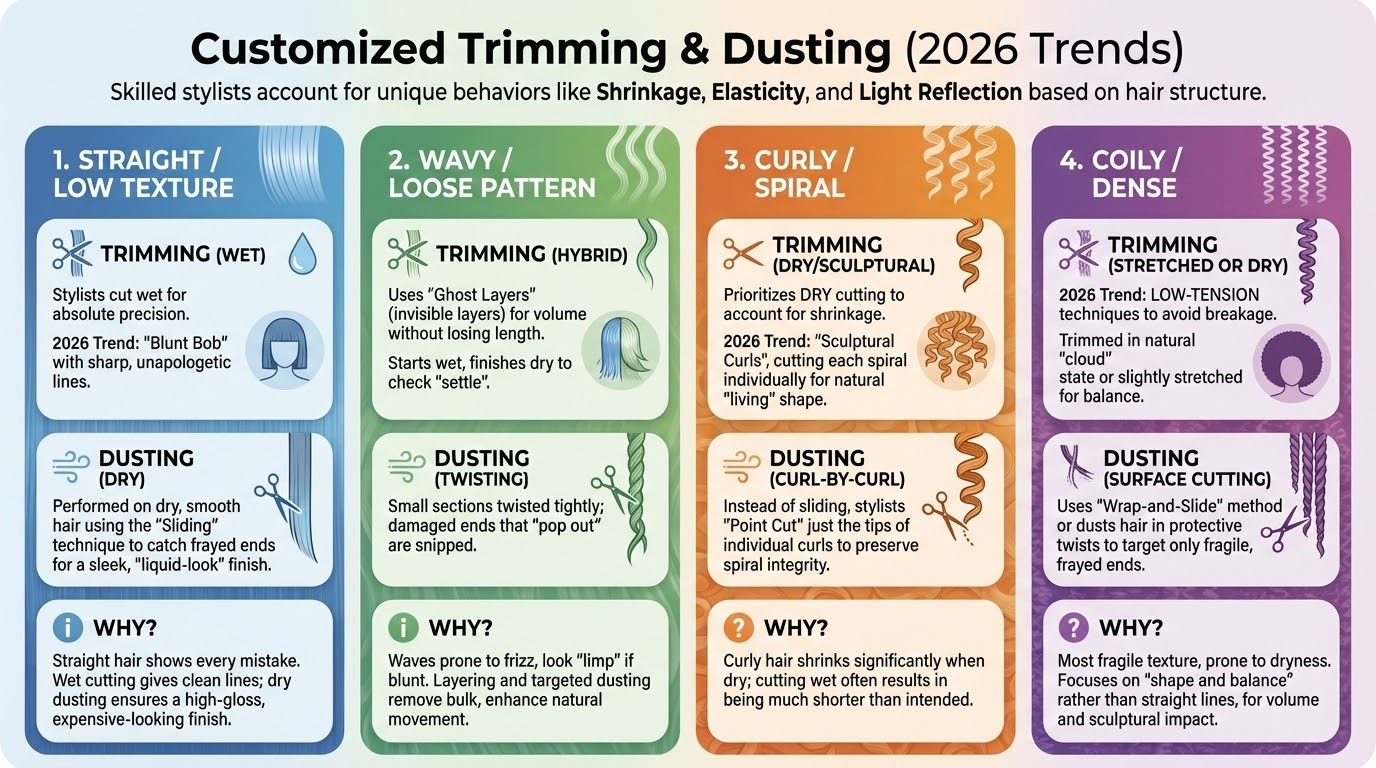
A: Yes, but most 2026 stylists perform this on dry hair. This allows them to see where the curls naturally clump and identify specific frayed ends without disrupting your pattern. It is an excellent way to maintain curl health and definition while ensuring you do not lose any noticeable length or volume.
Q: Does dusting remove all my split ends?
A: Dusting targets the most visible damage along the hair shaft rather than a straight line. While it removes a significant amount of fraying, it is a maintenance technique, not a total overhaul. For 2026, experts recommend combining dusting with professional bonding treatments to ensure the remaining hair stays strong and resilient.
Q: How often should I schedule a trim?
A: In 2026, professionals suggest every eight to twelve weeks, depending on your hair’s health and styling habits. If you frequently use heat tools or have chemically treated hair, you may need a trim sooner. Consistent maintenance prevents minor damage from turning into major split ends that require cutting off significant length later.
Q: Is dusting more expensive than a regular trim?
A: Prices vary, but many 2026 salons charge similarly for both services. Dusting is highly specialized and time-consuming because the stylist must meticulously work through small sections to find individual split ends. You are paying for the stylist’s precision and the benefit of keeping your hair length while removing only the damage.
Q: Will a trim change my current hairstyle?
A: A trim is specifically designed to maintain your existing shape and style by removing only the dead ends. In 2026, stylists focus on refreshing your current look rather than redesigning it. Unless you specifically request a new cut, a trim simply restores the health and bounce to your established hair silhouette.
Sources & Professional Consensus
The content of this article about Hair Trimming and Dusting aligns with published findings from:
- Industry trade publications: Modern Salon, American Salon, Behind The Chair
- Scientific & consumer advocacy sources: r/HaircareScience, The Beauty Brains
- High-fashion & lifestyle authorities: Allure, Vogue, InStyle
- Health & material research studies: National Institute of Health (PubMed)
A Proper New York Ending
Winter did not defeat your hair. It challenged it.
You already navigate sidewalks, schedules, and expectations daily.
Your hair deserves the same strategy.
Trim when structure matters. Dust when length matters.
Do not let the city decide for you.
Book your FREE 15-Minute Trimming vs. Dusting Consultation online today.
Or click-to-call 212-288-4413 to schedule easily.
Because surviving winter in New York is impressive.
Keeping your hair intact while doing it is iconic.
Coming Friday, January 30, 2026:
Part 5 of 5 of our January Seasonal posts:
- Should You Change Your Shampoo Seasonally?