(#1 in our 4-part August Post-Summer Restoration Diagnostic series)
Keywords: Yorkville damaged hair treatments · Upper East Side hair repair
Hair N’ Now NYC | Your Hair, Revived℠

Damaged Hair Isn’t One Problem
Retail hair masks make one seductive promise:
They can repair “damaged hair.”
But damaged hair can result from several different problems.
Your hair may be dehydrated.
It may be structurally weakened.
It may have excessive protein.
It may have suffered chemical damage.
It may have accumulated product buildup.
Or it may have several problems simultaneously.
That creates the biggest weakness in the retail-mask category:
One formula cannot remedy every type of damage.
At Hair N’ Now NYC, clients seeking Yorkville damaged hair treatments often discover something surprising.
Successful Upper East Side hair repair begins with identifying what went wrong.
More of the wrong product won’t solve an undiagnosed problem.
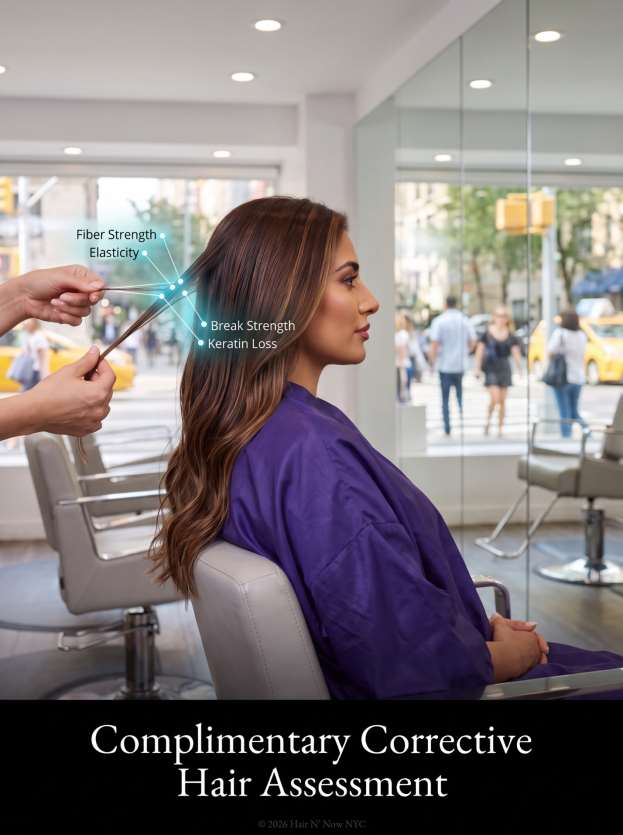
The Biggest Diagnostic Mistake
The most consequential mistake is confusing moisture depletion with structural damage.
These conditions can produce surprisingly similar sensations.
But they don’t necessarily need the same treatment.
If hair lacks moisture, it may feel dry, brittle, rough, and inflexible.
Adding excessive strengthening ingredients may make already-rigid hair feel even less flexible.
If hair is structurally weakened, the signs can look different.
Heavily bleached or chemically processed hair may feel unusually soft or stretchy when wet.
Adding moisture alone may not address the underlying weakness.
Softer does not necessarily mean stronger.
Different types of damage can produce similar symptoms.
Treatment should match the condition, not the marketing on the jar.
Most consumers never receive that assessment.
Instead, they choose a hyped brand-name mask promising “repair.”
That is where the trouble can begin.
Thick Does Not Mean Deep
A rich, buttery texture feels convincing.
It looks nourishing.
It feels luxurious.
But none of those qualities proves structural improvement.
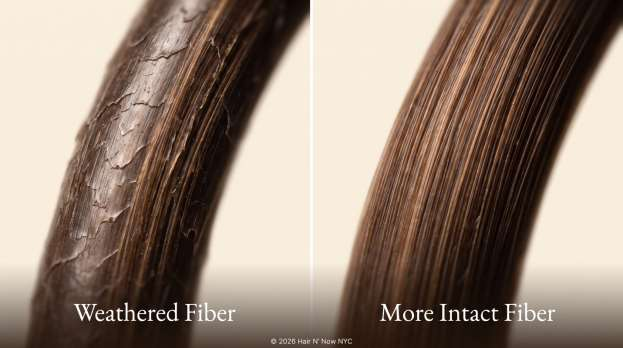
The hair shaft has an outer cuticle surrounding the cortex.
Effective treatment depends on appropriately formulated ingredients interacting with the hair fiber.
Some formulas rely heavily on larger conditioning materials.
These can primarily act at the hair’s surface.
The immediate result can be impressive.
Hair feels smoother.
It looks shinier.
It becomes easier to comb.
But that doesn’t necessarily mean underlying damage has been corrected.
Surface improvement and structural improvement are two different things.
That distinction is easy to miss when a product feels instantly effective.
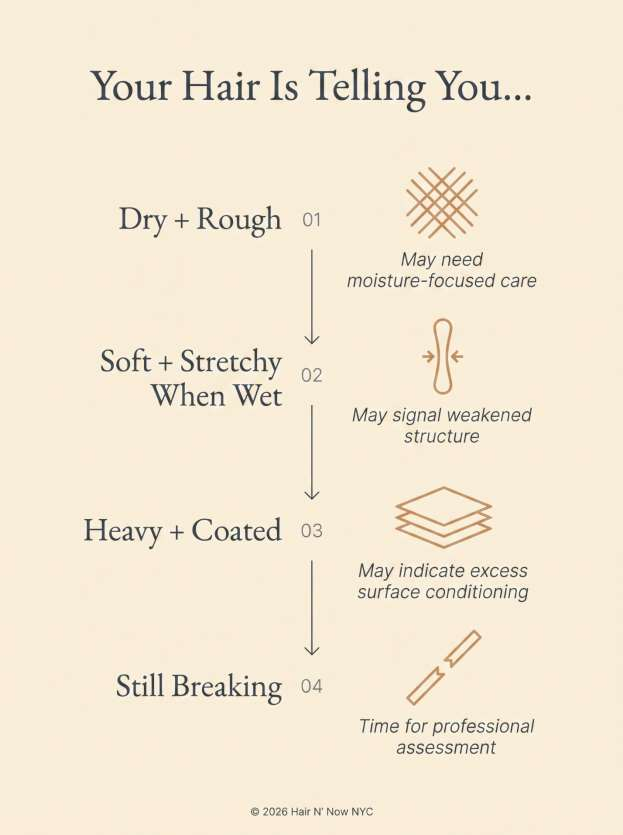
Listen To Your Hair’s Signals
Your hair often reveals how a treatment is affecting it.
Watch what happens after repeated use.
If your hair becomes:
- Heavy
- Flat
- Coated
- Difficult to rinse clean
Your mask may be providing too much surface conditioning.
If your hair becomes:
- Soft but weak
- Stretchy when wet
- Limp
- Increasingly difficult to style
Your hair may need more than moisture.
If your hair remains:
- Dry
- Rough
- Brittle
- Prone to snapping
The formula may be treating the wrong problem.
These signals matter.
Your hair is telling you something.
The question is whether you’re interpreting it correctly.
The Quiet Buildup Creep
Silicones, oils, and waxes are not automatically bad ingredients.
Many perform useful conditioning functions.
The problem begins when surface coating becomes the primary strategy.
A heavy film can temporarily smooth damaged cuticles.
Hair may look shinier.
It may feel softer.
But repeated product accumulation can change how hair behaves.
The result can be familiar:
Hair looks better immediately.
Then it progressively feels worse.
Consumers often respond by applying more product.
That can create even more surface coating.
Sometimes the answer isn’t another mask.
It may be removing what is already there.
Conditioning Isn’t Bond Repair
Chemical bleaching, permanent waving, and repeated high-heat styling can cause significant structural damage.
Ordinary deep conditioning can improve softness and manageability.
But conditioning is not the same objective as structural repair.
Specialized bond-building treatments approach certain forms of damage differently.
They use targeted chemistry intended to address specific aspects of the hair fiber.
That makes an important distinction:
Softness is a sensory result.
Structural repair is a different objective.
A mask may deliver the first without delivering the second.
Don’t Sleep With Your Mask On
Another widespread belief seems superficially logical:
If five minutes helps, then overnight must help more.
Not necessarily.
Hair interacts continuously with water.
Repeated swelling and contraction can contribute to a phenomenon commonly called “hygral fatigue.”
That doesn’t mean every longer treatment damages hair.
It means more treatment time does not automatically mean better treatment.
Follow the manufacturer’s directions.
Then pay attention to how your hair responds.
Your hair doesn’t become healthier simply because you leave a product on longer.
What Professionals See First
Expert stylists don’t begin with:
“Which mask should I sell you?”
They begin with:
“What happened to your hair?”
They evaluate several things.
Your chemical history:
Color, bleaching, chemical services, and previous treatments can matter.
Your heat history:
Frequency and intensity of thermal styling can matter too.
Your hair elasticity:
How the strand stretches and recovers can provide useful information.
Your hair’s texture and condition:
Dryness, brittleness, softness, roughness, and breakage all matter.
Product buildup:
Existing surface buildup can affect how hair feels and behaves.
The right diagnosis should come before the right treatment.
The Biggest Misconception
Many people think:
“This mask isn’t working.”
Sometimes that’s true.
But sometimes the mask is doing exactly what it was designed to do.
The problem is that your hair needs something else.
A moisturizing mask cannot solve every structural problem.
A strengthening mask cannot solve every moisture problem.
A conditioning film cannot replace structural treatment.
And leaving any mask on longer doesn’t make it more appropriate.
Your hair needs the right treatment for your specific problem.
Professional Consensus
Our every article begins with extensive research.
We compare multiple trusted professional sources.
We look for consistent areas of agreement.
We translate those findings into practical guidance.
Then we simplify the science without oversimplifying the problem.
Our goal is simple:
Help you make better hair decisions.
Complimentary Corrective Hair Assessment
Buying another repair mask isn’t always the answer.
Knowing what your damaged hair actually needs usually is.
At Hair N’ Now NYC, we begin by assessing your hair’s condition and history.
Sometimes the answer is moisture replenishment.
Sometimes it’s structural strengthening.
Sometimes it’s removing buildup.
Sometimes it’s targeted professional treatment.
And sometimes the smartest recommendation is simply:
Stop using what isn’t helping.
Your hair shouldn’t have to adapt to your products.
Your products should adapt to your hair.
Your Hair, Revived℠

Schedule a Complimentary Corrective Hair Assessment at Hair N’ Now NYC.
Together, let’s determine what your hair needs before you spend more money trying to fix it.
Explore our:
Click to call us at (212) 288-4413.
Or simply walk in.
Your 10028 hair stylist. Open seven days a week:
- Monday–Saturday: 8:00 AM–7:30 PM
- Sunday: 9:00 AM–7:00 PM