(Part 5 of 5 of our April Color Refresh series)
Keywords: color correction Yorkville · fix box dye NYC
Hair N’ Now NYC | Your Hair, Revived℠
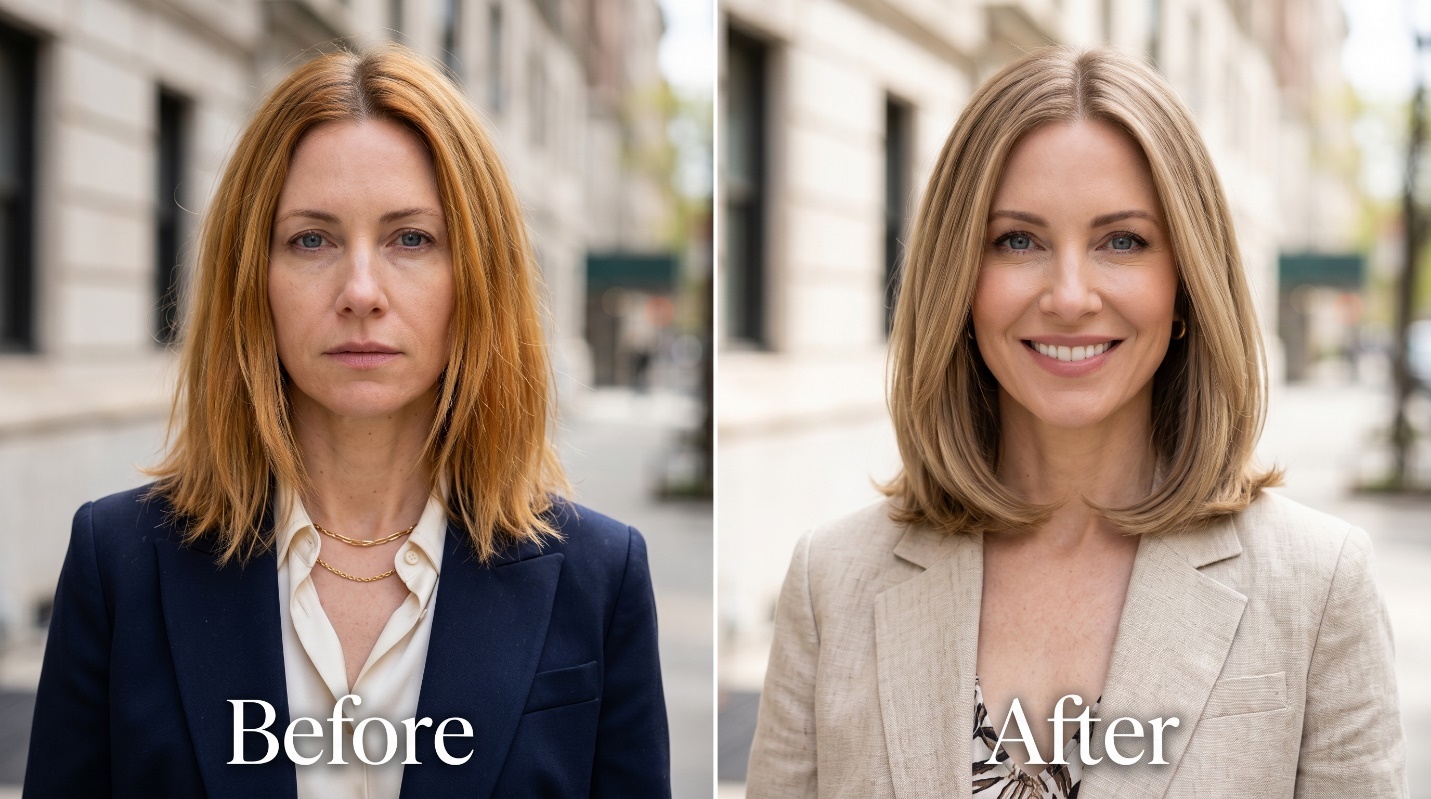
It looked fine — until daylight
There’s a particular kind of betrayal that only bathroom lighting can deliver.
At home, everything feels… acceptable. The tone looks close enough. The blend doesn’t seem offensive. You tilt your head slightly, adjust your part, and decide it works.
Then you step outside in New York daylight.
And suddenly, it doesn’t.
The warmth is louder than you expected. The ends feel disconnected from the roots. There’s a faint — or not-so-faint — banding that wasn’t visible before. What you thought was “good enough” now feels unfinished, uneven, or strangely artificial.
This is usually the moment people start searching for color correction Yorkville or fix box dye NYC. It feels like a color problem.
It isn’t.
It’s a diagnosis problem.
Because what changed wasn’t your hair — it was the lighting. And lighting has a way of exposing what the process missed.
DIY Box dye isn’t the real problem
It’s easy to blame the box stuff.
And yes, at-home do-it-yourself color can introduce complications — uneven saturation, unpredictable lift, tonal imbalance. But focusing on the product alone misses the larger issue.
Salon corrections fail too. Quietly. Frequently.
Because the real problem isn’t what was used — it’s what was assumed.
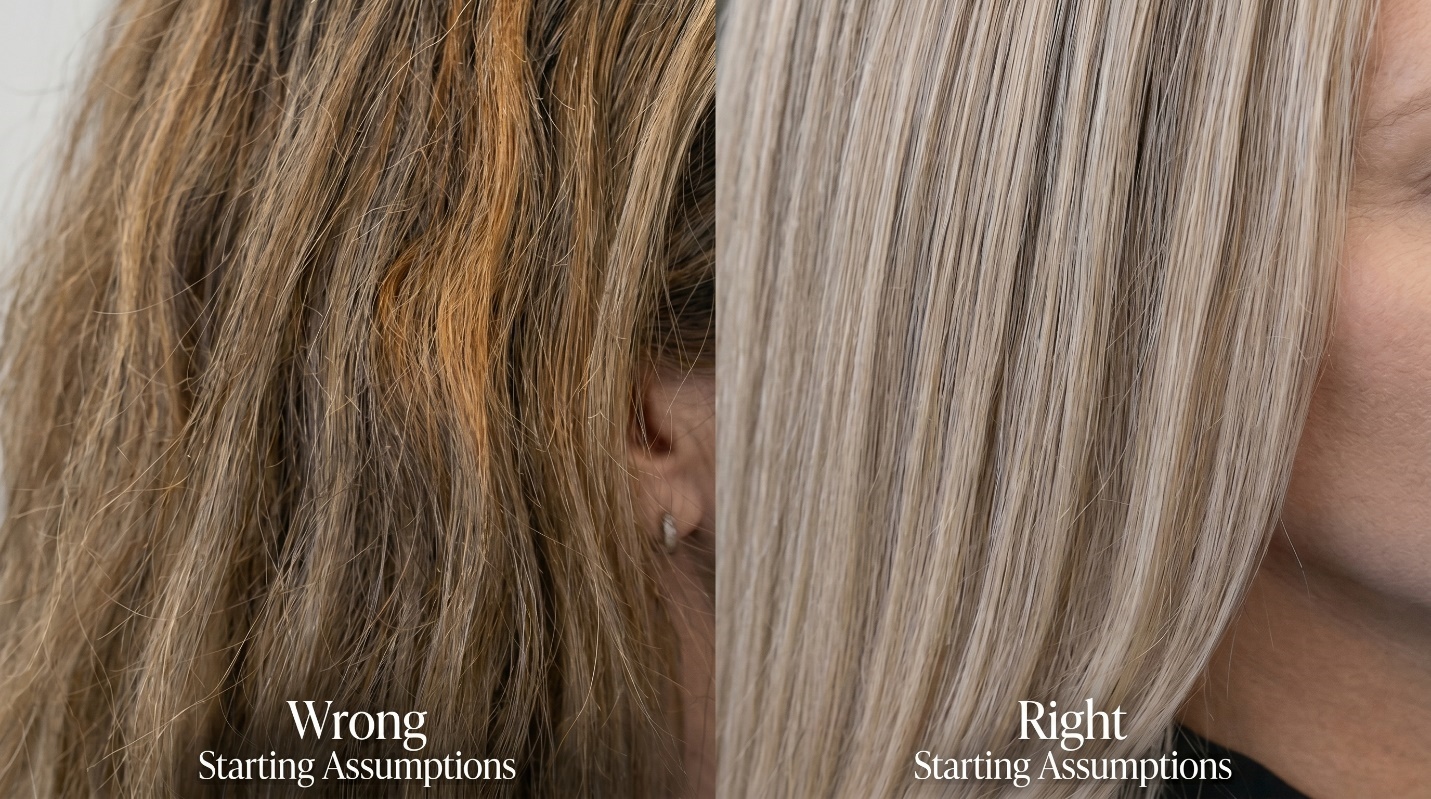
Chemical Failure Type: Misidentified Base + Undertone
|
Variable |
What’s Assumed |
What’s Actually There |
Result |
|---|---|---|---|
|
Natural base level |
“Medium brown” |
Level 5 with warm undertone |
Over-lifting, brassiness |
|
Previous color |
“Faded” |
Layered pigment buildup |
Uneven absorption |
|
Undertone exposure |
“Neutral” |
Strong orange/red |
Incorrect toner selection |
|
Hair condition |
“Healthy” |
Porous mid-lengths |
Patchy correction |
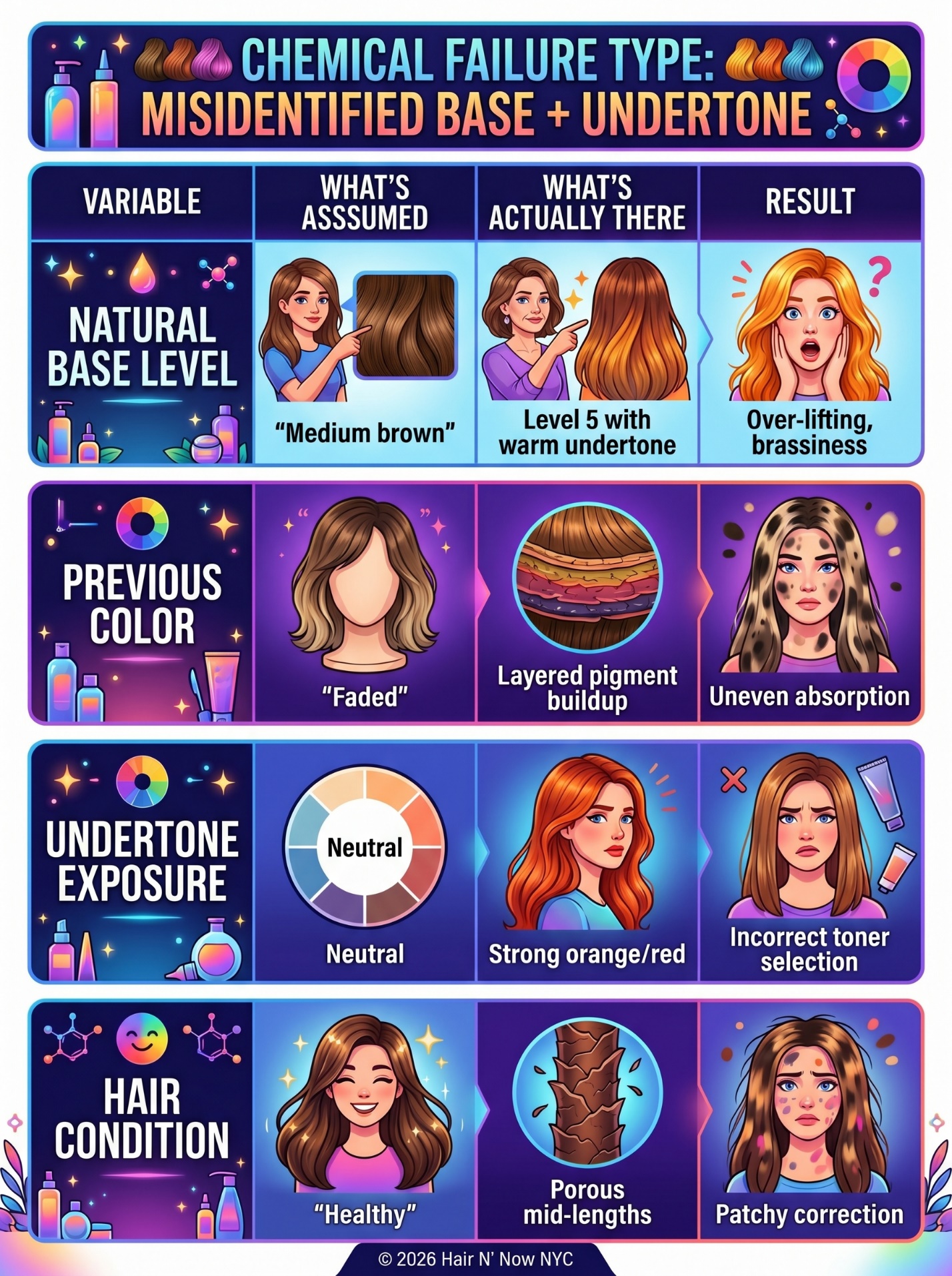
Product is not the root cause. Misidentification is.
When base and undertone are read incorrectly, every step that follows becomes a compensation — not a correction.
Most corrections guess, then compound
There’s a quiet industry habit that rarely gets discussed openly.
Not out of malice. Out of momentum.
Time constraints. Client expectations. Visual estimation. Pattern recognition.
And so, many corrections begin with an educated guess.
The problem is what happens next.
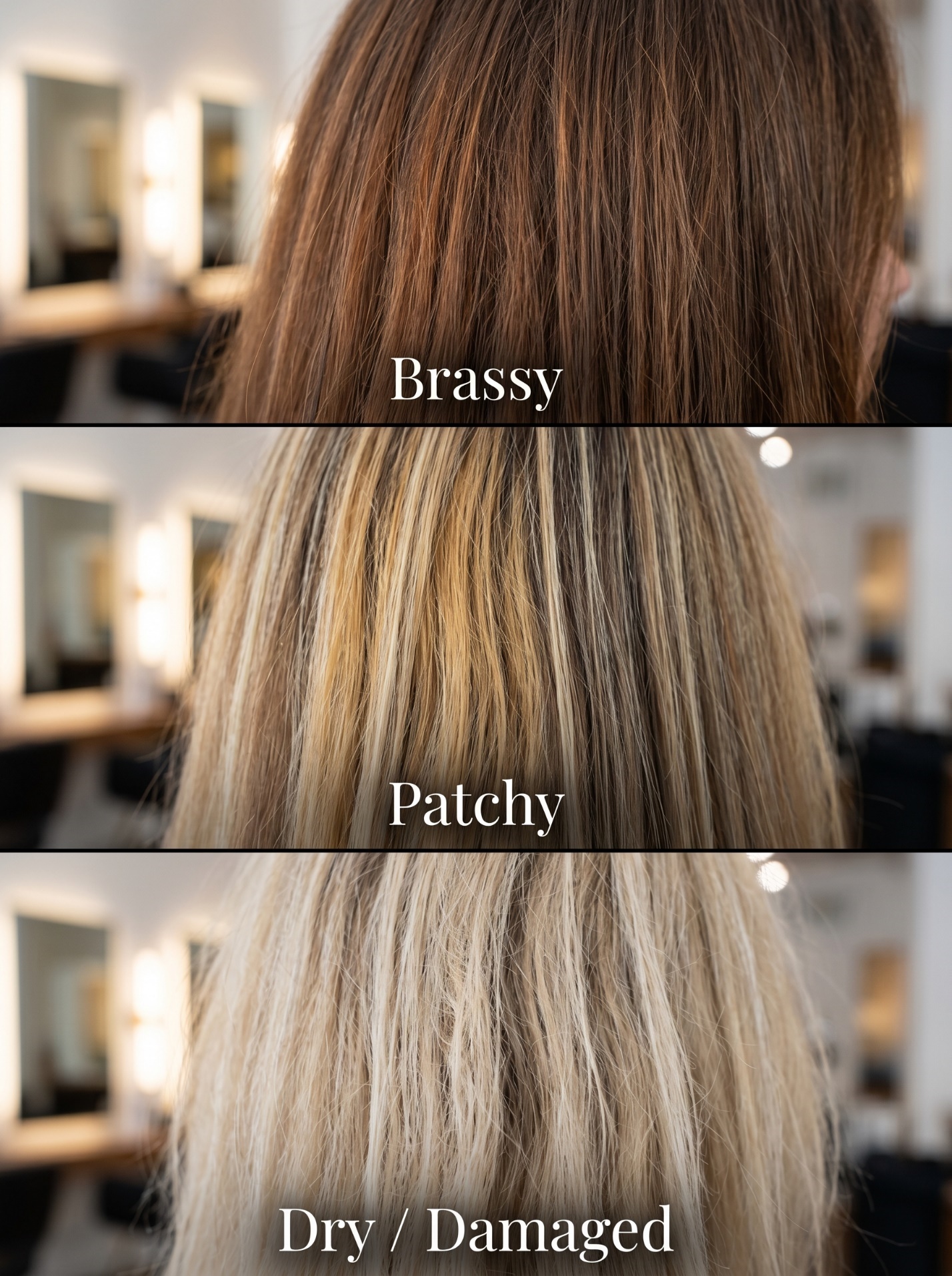
The Cascade Effect
|
Step |
Intended Action |
Actual Outcome |
|---|---|---|
|
Tone adjustment |
Neutralize warmth |
Overcorrection (ash/green cast) |
|
Reapplication |
Even out color |
Overlapping damage |
|
Porosity response |
“Fix dryness” |
Uneven absorption intensifies |
|
Final gloss |
Blend result |
Masks inconsistency temporarily |
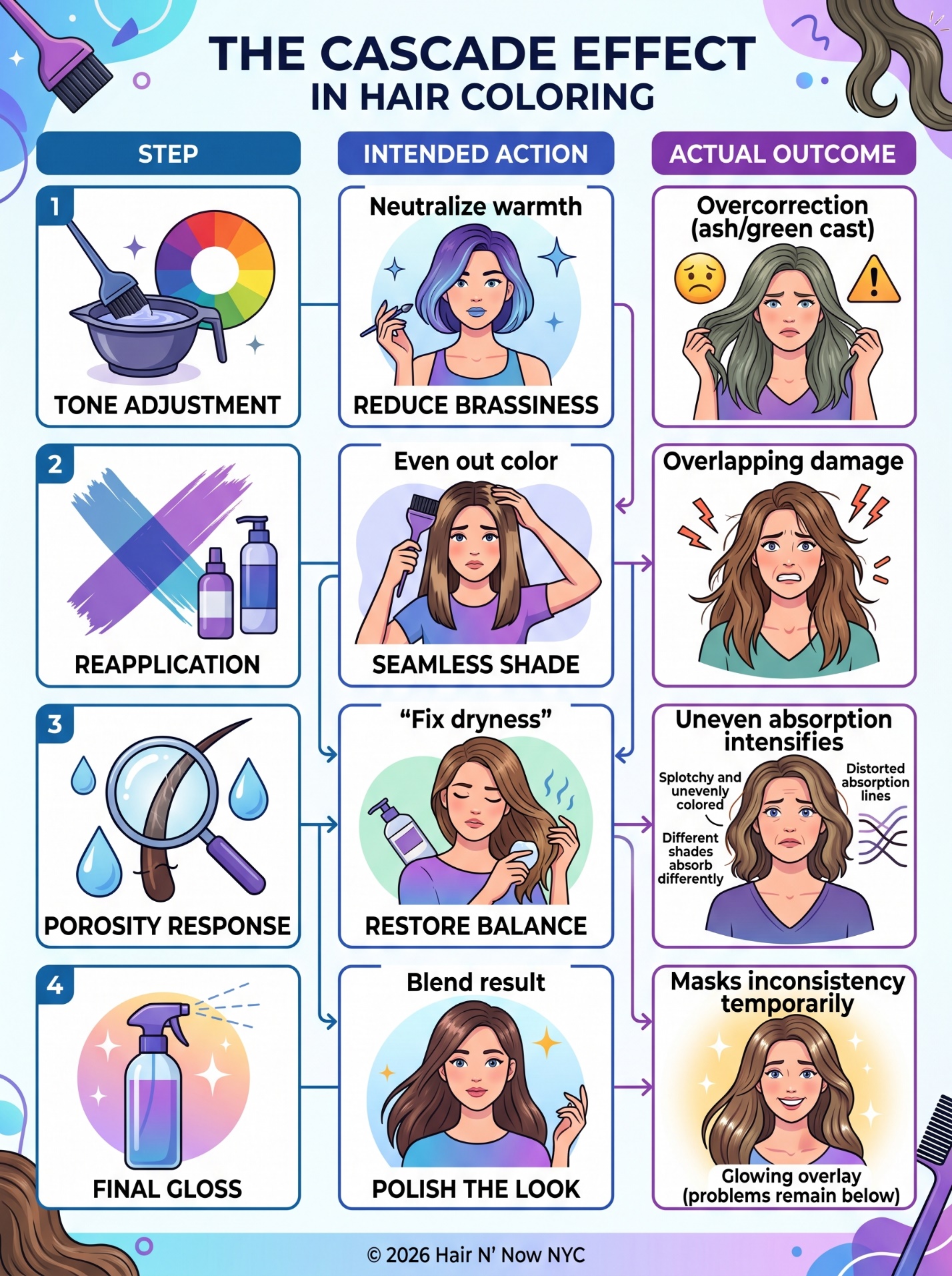
What begins as a small misread becomes layered complexity.
Not dramatic. Not catastrophic.
Just increasingly unpredictable.
And importantly — this is not rare.
It’s common.
Hair remembers everything you’ve done
Hair is not a blank canvas.
It’s a record.
Every color. Every heat tool. Every gloss. Every attempt to “fix” something quickly.
All of it remains — chemically, structurally, and visually.
What Your Hair Memory Looks Like
|
Condition |
Description |
Why It Matters |
|---|---|---|
|
Porosity variation |
Uneven absorption across strands |
Color grabs inconsistently |
|
Banding |
Visible lines of previous color applications |
Breaks visual continuity |
|
Overlap zones |
Repeated processing areas |
Increased fragility |
|
Pigment buildup |
Residual artificial color layers |
Alters lift and tone outcome |
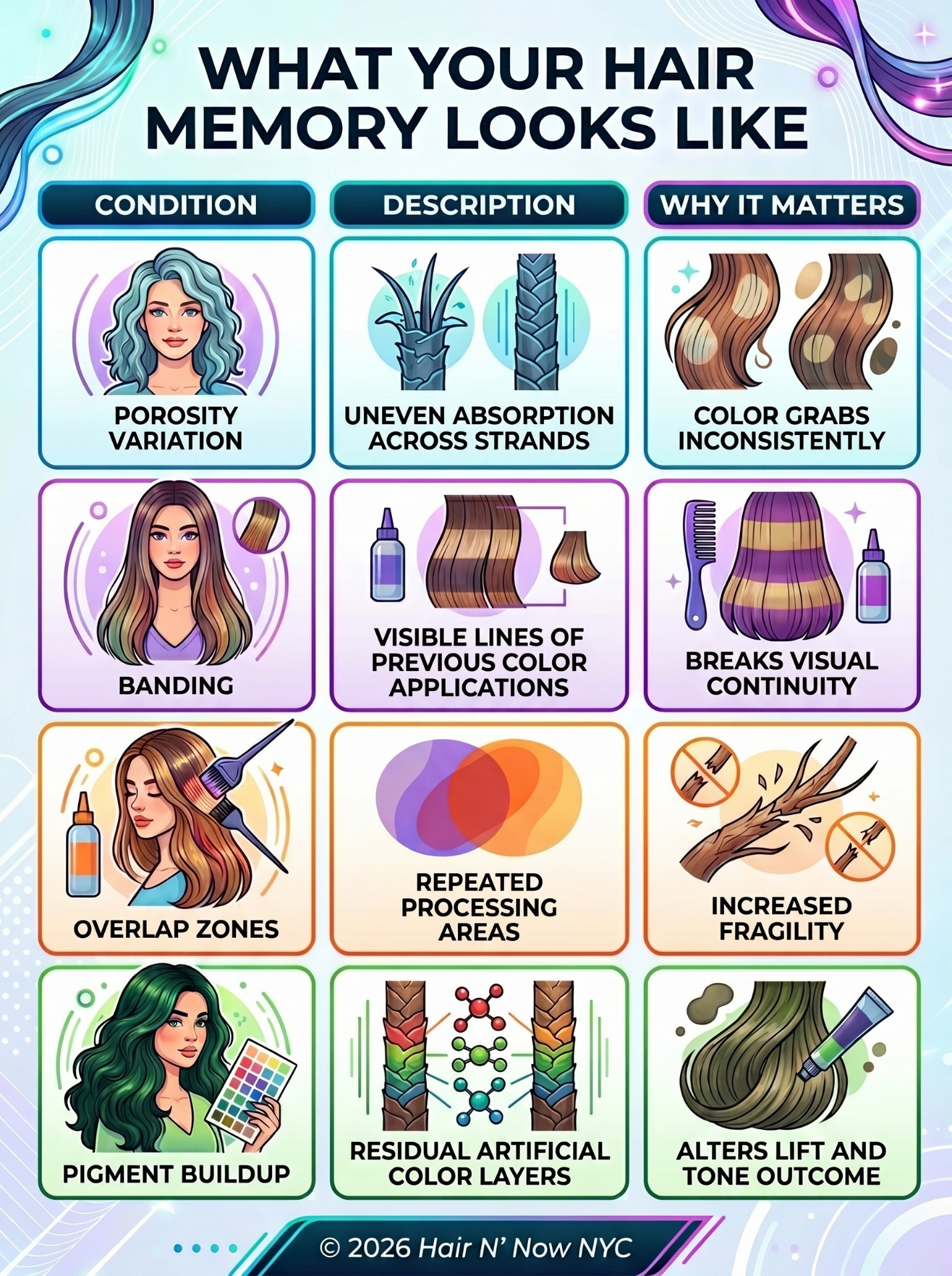
This is where most correction approaches quietly fall apart.
Because they treat the hair as current — when it’s actually cumulative.
Key Insight
If your color feels uneven, unpredictable, or overprocessed, it’s usually not just the color — it’s the diagnosis.
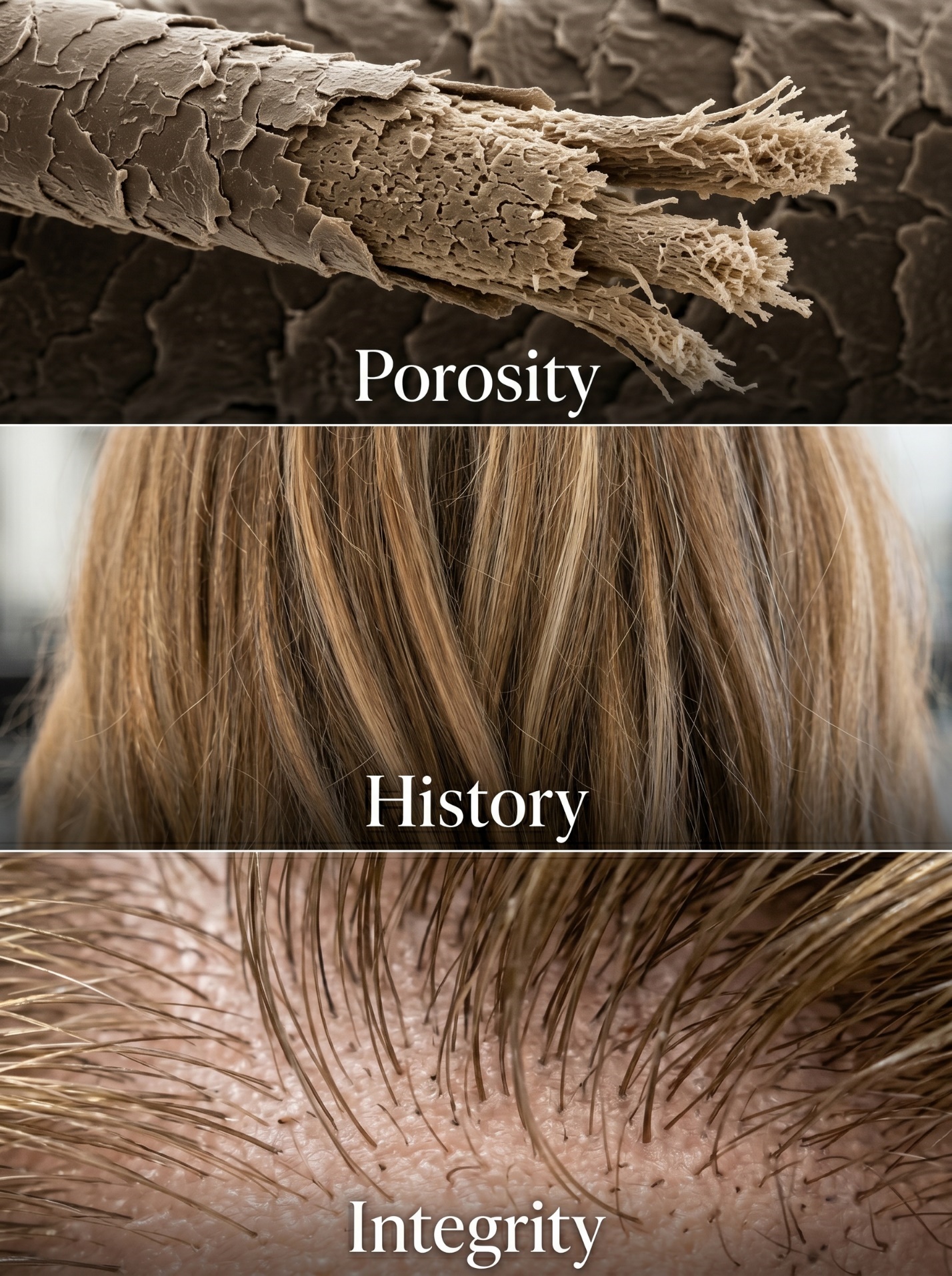
A proper correction starts with understanding what your hair has already been through.
The mirror lies; The strand doesn’t
Visual assessment is persuasive.
But it’s also misleading.
Hair can look one way — and process another.
This is where strand testing shifts everything.
Why Strand Testing Matters
|
Observation Type |
What It Shows |
Limitation |
|---|---|---|
|
Mirror assessment |
Surface tone + blend |
Doesn’t predict processing |
|
Touch/texture |
Softness/roughness |
Doesn’t reveal chemical limits |
|
Strand test |
Real processing behavior |
Predictive + controlled |
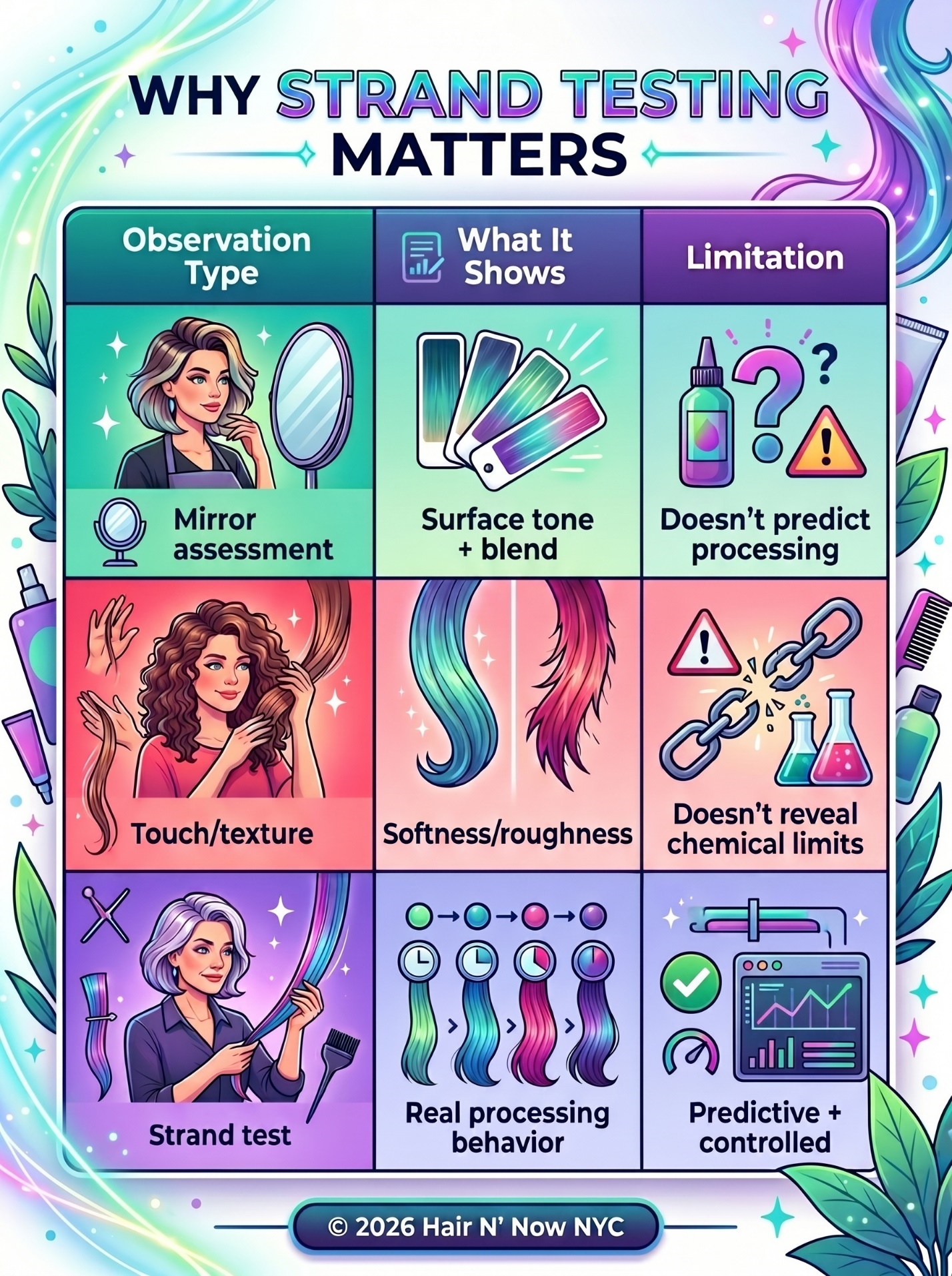
A strand test answers the only question that actually matters:
What will this hair do under chemical stress?
Not what it looks like.
Not what it “should” do.
What it will do.
And that’s where trust begins to form — not through reassurance, but through proof.
Correction starts before any color
The visible work is only part of the process.
The invisible work is where the outcome is decided.
The Diagnostic Framework
|
Step |
Purpose |
Outcome |
|---|---|---|
|
Consultation |
Identify goals vs reality |
Alignment |
|
History mapping |
Track all prior treatments |
Full context |
|
Strand testing |
Predict processing behavior |
Risk control |
|
Staged correction |
Gradual, controlled adjustment |
Stability + integrity |
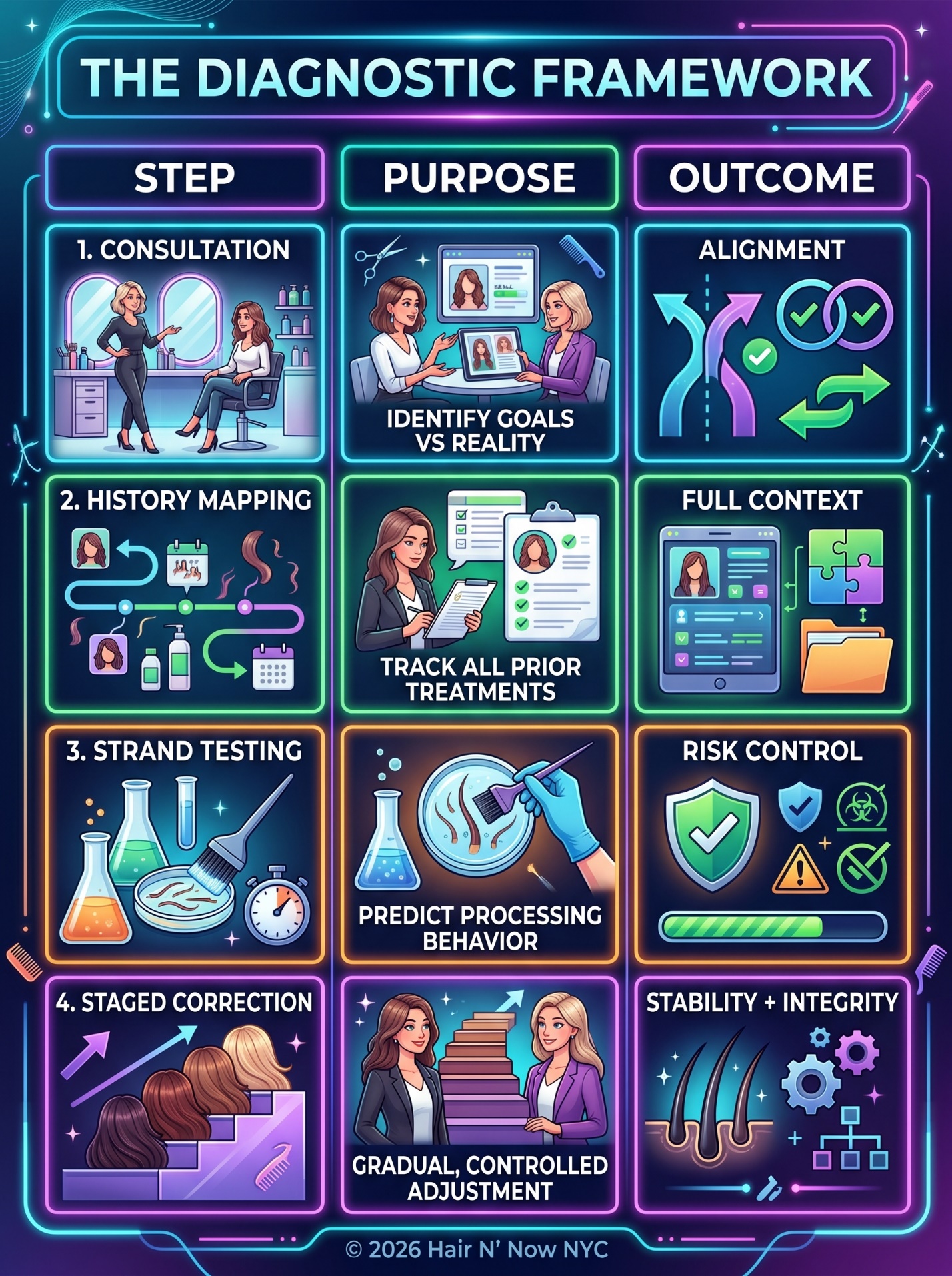
Most clients never see this sequence elsewhere.
Because it happens before anything “visible” begins.
But this is the difference between correction and controlled restoration.
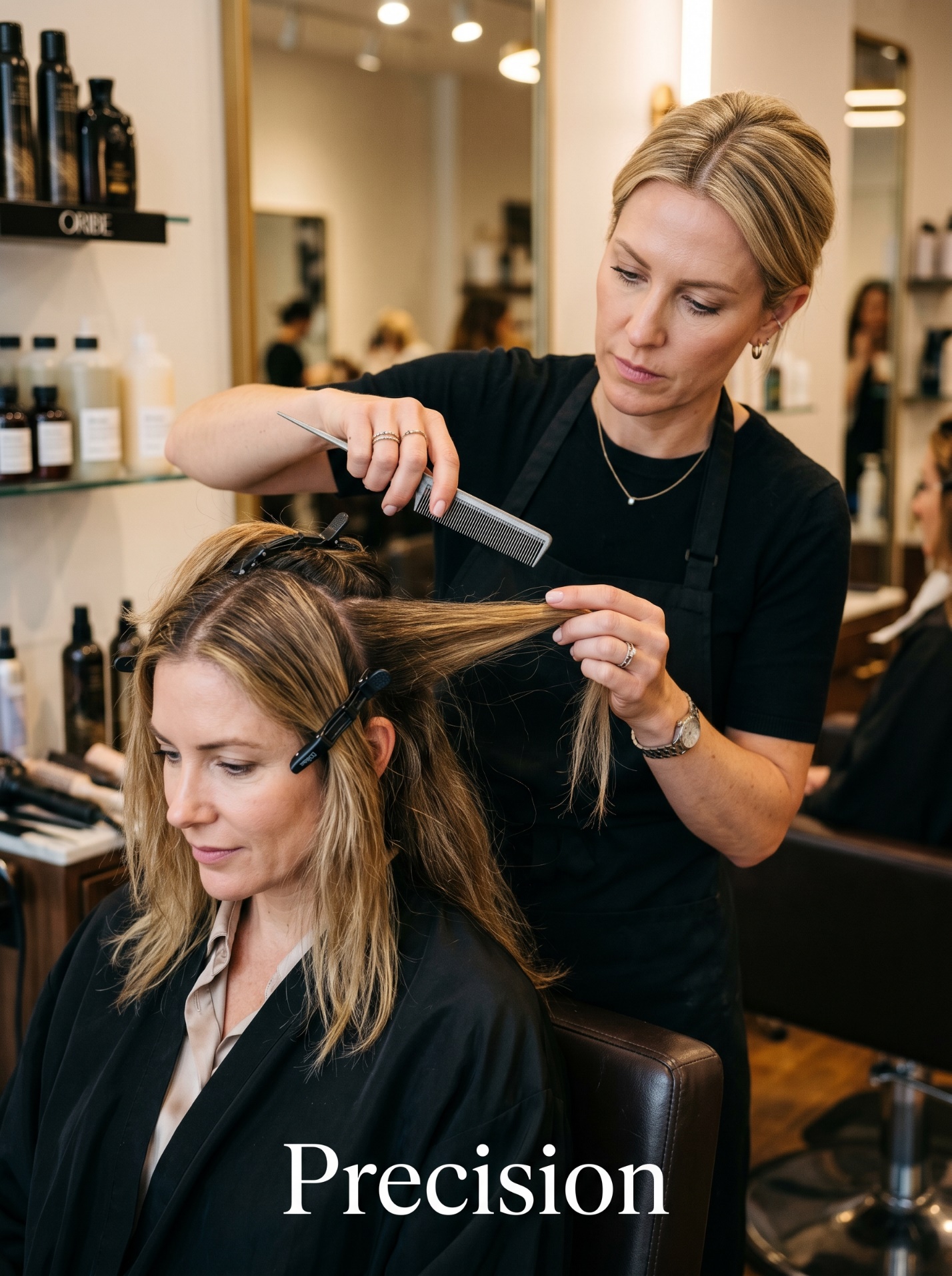 Hair N Now NYC colorist carefully sectioning a client’s blonde hair in the salon before a precision color correction consultation.” />
Good color is quiet, not LOUD
There’s a certain kind of result that doesn’t ask for attention.
It doesn’t look “fixed.”
It doesn’t announce itself.
It simply looks… right.
What Quiet Color Looks Like
|
Feature |
LOUD Correction |
Quiet Correction |
|---|---|---|
|
Tone |
Over-neutralized |
Balanced, natural |
|
Transition |
Noticeable shifts |
Seamless blend |
|
Shine |
Artificial gloss |
Soft reflection |
|
Dimension |
Flat or overly contrasted |
Subtle depth |
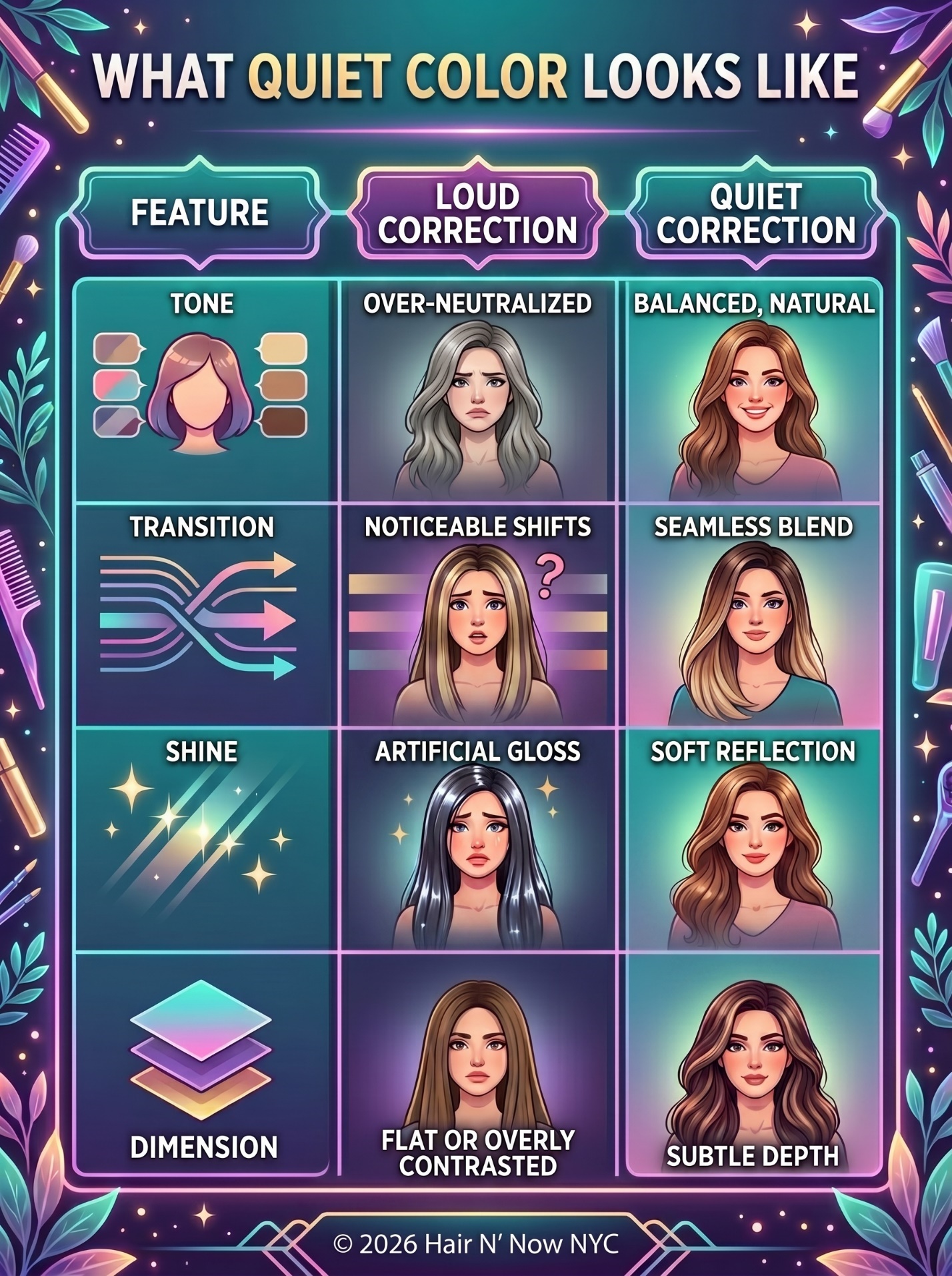
This is especially relevant for clients who don’t want to think about their hair constantly.
Who want consistency, not maintenance anxiety.
Who prefer outcomes that hold — not fluctuate.
Revived hair doesn’t announce itself
At a certain point, the goal shifts.
From correction… to coherence.
From fixing… to restoring.
From visible effort… to quiet alignment.
That’s what “Your Hair, Revived” actually means.
Not dramatic transformation.
Not before-and-after spectacle.
Just hair that behaves the way it should have all along.
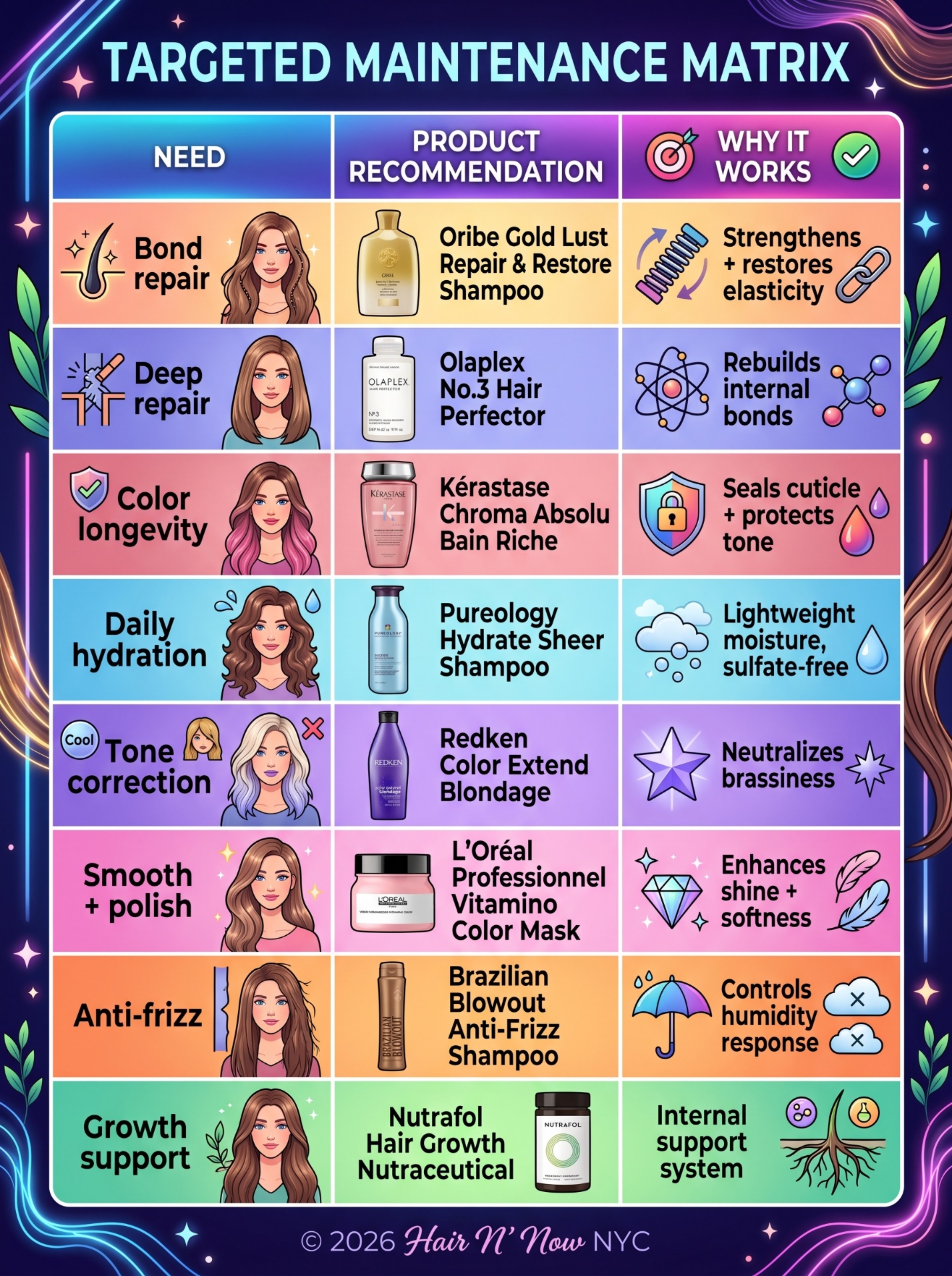
Pro Tips Product Recommendations
(At-home + on-the-go support system)
Targeted Maintenance Matrix
|
Need |
Product Recommendation |
Why It Works |
|---|---|---|
|
Bond repair |
Oribe Gold Lust Repair & Restore Shampoo |
Strengthens + restores elasticity |
|
Deep repair |
Olaplex No.3 Hair Perfector |
Rebuilds internal bonds |
|
Color longevity |
Kérastase Chroma Absolu Bain Riche |
Seals cuticle + protects tone |
|
Daily hydration |
Pureology Hydrate Sheer Shampoo |
Lightweight moisture, sulfate-free |
|
Tone correction |
Redken Color Extend Blondage |
Neutralizes brassiness |
|
Smooth + polish |
L’Oréal Professionnel Vitamino Color Mask |
Enhances shine + softness |
|
Anti-frizz |
Brazilian Blowout Anti-Frizz Shampoo |
Controls humidity response |
|
Growth support |
Nutrafol Hair Growth Nutraceutical |
Internal support system |
Questions About Color Correction
We hear these every day, from clients in one of our 9 chairs.
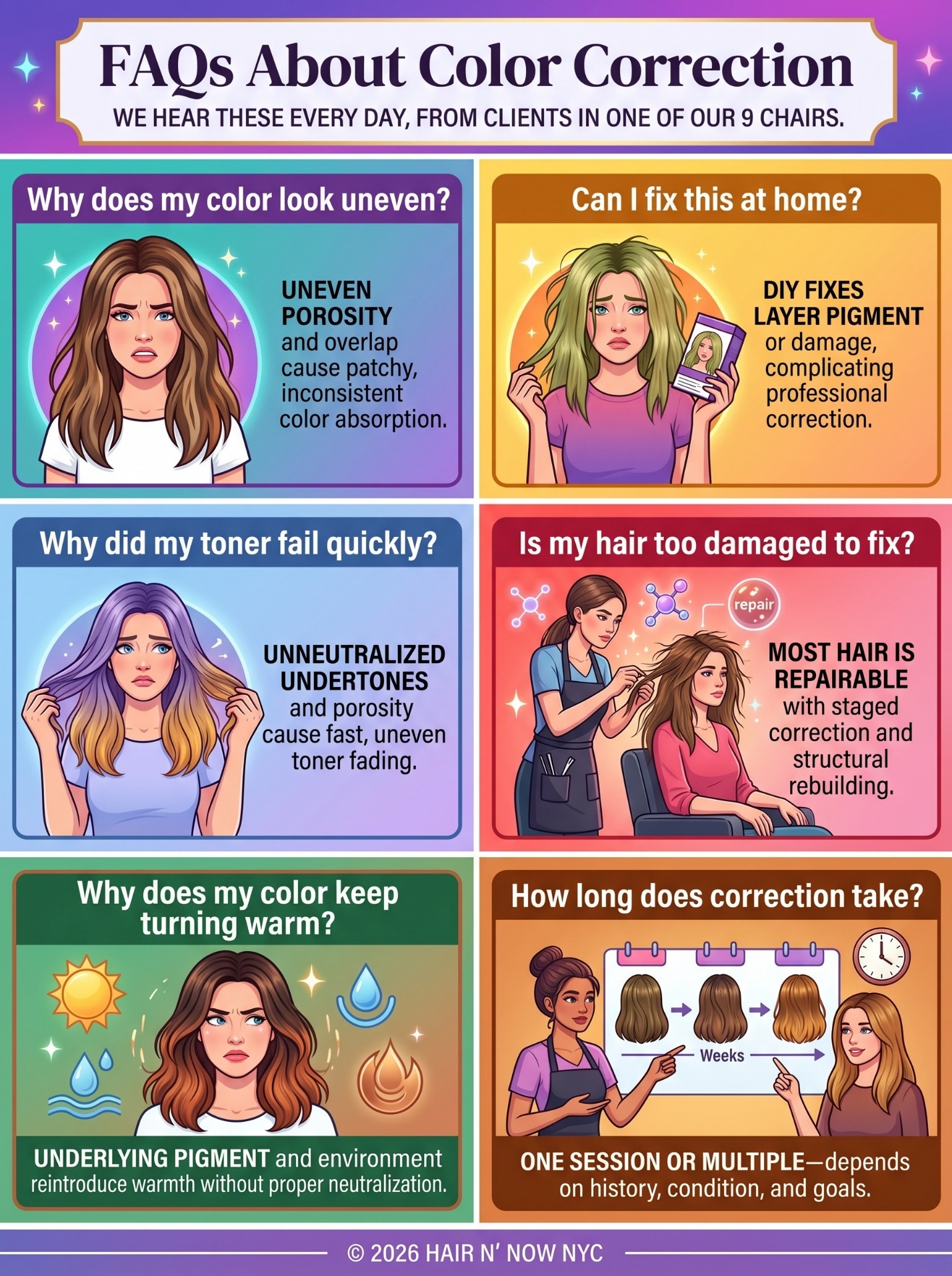
Why does my color look uneven?
Uneven color usually reflects inconsistent porosity or previous overlapping applications. Hair absorbs pigment differently depending on its condition and history. Without proper diagnosis, corrections amplify these inconsistencies rather than resolve them, creating patchy or unpredictable results instead of a smooth, cohesive finish.
Can I fix this at home?
Minor tonal adjustments may improve slightly at home, but true correction requires understanding underlying chemical structure and history. Without that, do-it-yourself at-home attempts often layer additional pigment or damage, making future professional correction more complex, time-intensive, and less predictable in outcome.
Why did my toner fail quickly?
Toners fail when underlying pigment wasn’t properly identified or neutralized. If warm undertones remain strong, they resurface quickly. Additionally, porous hair releases toner faster, causing uneven fade. Without correcting the base condition first, toner becomes temporary camouflage rather than a lasting solution.
Is my hair too damaged to fix?
Hair is rarely beyond improvement, but the approach must adapt. Highly compromised strands require staged correction and structural repair before aesthetic changes. Attempting aggressive correction too soon risks further breakage, whereas controlled restoration gradually rebuilds both integrity and visual coherence.
Why does my color keep turning warm?
Warmth returns when underlying pigment isn’t fully addressed or when external factors like water, heat, and oxidation influence tone. Without proper neutralization and maintenance strategy, warmth resurfaces repeatedly, making it seem like the color “won’t hold,” when the issue is foundational.
How long does correction take?
Correction timelines vary based on history, condition, and goals. Some cases improve in one session, while others require multiple staged visits to protect hair integrity. Rushing the process often leads to damage or inconsistency, whereas a phased approach ensures stability, predictability, and lasting results.
What This Advice Is Based On
Industry Expertise
- Modern Salon — “Color Correction Hub”, Color Correction.
- Behind the Chair — “6 Color Consultation Questions to Ask Your Clients”, 6 Consultation Questions to Ask Your Color Clients.
Editorial Validation
- Allure — “How My Colorist Corrected My Splotchy Hair-Dye Mess Without a Drop of Bleach”, Color Correction Fix Bad Hair Dye Job Before After Photos.
- Vogue Beauty — “Why Professional Diagnosis Matters”.
Scientific Context
- PubMed — Hair Porosity and Chemical Treatment Studies
- Journal of Cosmetic Science — Effects of Oxidative Hair Coloring
Your Hair, Revived℠

Color correction isn’t about fixing what’s visible.
It’s about understanding what isn’t.
Book a FREE 15-minute Hair Consultation online now. Or just click-to-call us at (212) 288-4413 now to schedule your session. Or feel free to walk-in to Hair N’ Now NYC if you’re in the neighborhood.
We’re here seven days a week — Monday through Saturday from 8:00 AM to 7:30 PM, and Sundays from 9:00 AM to 7:00 PM. Short on time? Bring your hair history — we’ll map the rest.